

Table of Contents
- What Actually Makes Sleep Mask Headphones Comfortable
- Sleep Headphones for Side Sleepers: What to Check Before You Buy
- Bluetooth Sleep Mask With Headphones: Pairing, Battery, and All-Night Reliability
- Sleep Headphones for Snoring: Masking Noise Without Ear Pain
- Washable Sleep Headphones: Hygiene, Care, and Long-Term Durability
- Safety, Hearing Health, and Fit Across Head Sizes
- Common Mistakes When Choosing Sleep Mask Headphones
- Conclusion
- Frequently Asked Questions
Last Updated: October 8, 2026
What Actually Makes Sleep Mask Headphones Comfortable
Comfort in sleep mask headphones comes down to three things: speaker thickness, fabric softness, and even pressure distribution. Get any of those wrong and you will be adjusting the band at 2 a.m.
At SleepBandZ, we built our wireless sleep headphones around one stubborn problem: most sleep headphones are designed for back sleepers, leaving side sleepers out.

Sleep Foundation guidance on creating a comfortable sleep environment makes the point plainly: noise and light are two of the most common disruptors of sleep, and both are exactly what a sleep mask with built-in headphones is meant to address.
The Three Comfort Killers: Eye Pressure, Ear Pressure, and Heat
Eye pressure is the most common complaint. A mask that sits flat against your eyelids pushes on your eyes every time you roll over.
Ear pressure affects anyone transitioning from earbuds. Earbuds seal the ear canal and cause soreness during long-term wear; flat speakers that rest outside the canal avoid that entirely.
Heat builds up with non-breathable material. A soft fabric headband with breathable construction keeps air moving across your skin.
Sleep Headphones for Side Sleepers: What to Check Before You Buy
For side sleepers, the single most important spec is speaker thickness. Ultra-thin, soft speakers that sit flat against your ear are the difference between a full night's sleep and a nightly wrestling match with your headband.
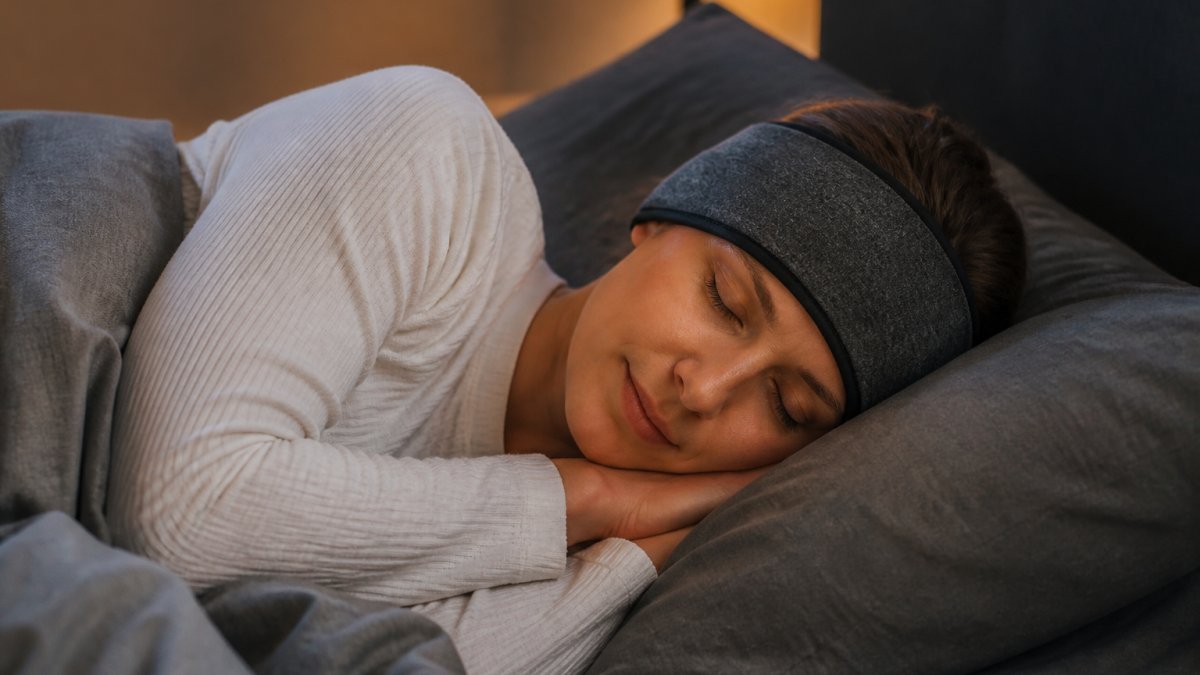
Here is what to check before you buy sleep headphones for side sleepers:
- Speaker profile: Flat, disc-shaped speakers, not raised drivers that create a lump under your ear
- Padding around the eyes: Contoured or foam-padded eye areas so your eyelashes are not pressed against fabric
- Band width: A wider band spreads pressure instead of concentrating it at one point
A common mistake is buying on speaker specs alone. For side sleeping, physical profile matters far more than audio hardware.
Bluetooth Sleep Mask With Headphones: Pairing, Battery, and All-Night Reliability
A Bluetooth sleep mask with headphones lives or dies on two things: does it pair reliably, and does the battery last the whole night. Here is how pairing quirks and battery drain actually work, so you can predict night 90, not just night one.
How Bluetooth pairing actually works in a sleep mask
Sleep mask headphones use the same Bluetooth radio as any earbud or speaker, but the electronics module, a small PCB with an antenna, battery, and Bluetooth chip, is usually tucked into a pocket at the back or side of the headband. Because the antenna sits against your head and under fabric, signal strength is lower than a phone or over-ear headphone. That matters in two situations:
- Phone on the far side of the room. Bluetooth Class 2 devices are typically rated for about 10 meters in open air, but a head and a pillow absorb signal. If your phone charges across the bedroom, expect dropouts. Keeping the phone on the nightstand on the same side as the headband's antenna pocket is the simplest fix.
- Crowded 2.4 GHz environments. Wi-Fi routers, baby monitors, and apartment neighbors all share the 2.4 GHz band. If pairing is flaky only at home and fine at a hotel, interference is the likely cause, not a defective unit.
Pairing itself is standard: hold the power button until the LED flashes, select the device in your phone's Bluetooth menu, done. Most masks auto-reconnect when powered on. The failure mode to watch for is a mask that reconnects to the last device it saw, not the one you want; if you pair it with both a phone and a tablet, you may need to disable Bluetooth on one to force the other.
Battery life: what the spec sheet does not tell you
Stated battery life is measured under ideal conditions: low volume, continuous playback, room temperature. Real-world runtime drops for three predictable reasons.
- Volume. Doubling perceived loudness draws meaningfully more power from a small lithium cell. Listen at 50% instead of 20% and expect a shorter night.
- Cold. A cold bedroom slows the chemical reaction inside a lithium battery. A mask that runs 10 hours at 22°C may run noticeably less at 15°C.
- Battery age. Lithium cells lose capacity over charge cycles. A mask rated for 10 hours new may deliver 7-8 hours after a year of nightly use. This is normal, not a defect.
When comparing options, look for:
- Stated battery life versus realistic use: Check whether the figure assumes low volume or continuous playback, and look for reviewers reporting runtime at normal bedtime volume
- Charging time and connector: USB-C is now standard and charges faster than micro-USB; a full charge typically takes 1-2 hours
- Low-battery alerts: Some devices beep or announce low battery, which can wake you at 3 a.m. Check for it if that would bother you
All-night reliability: the small details that decide it
Three design choices separate a mask that survives 300 nights from one that frustrates you by month three:
- Button placement. Physical buttons on the side of the headband get pressed when you roll onto them. A flat, recessed, or top-mounted control panel is far less likely to trigger accidentally.
- Charging port cover. An exposed USB port against your pillow collects lint and sweat. A rubber flap or a port positioned away from the contact surface lasts longer.
- Firmware and codec support. Most sleep masks use SBC, the baseline Bluetooth codec, fine for white noise and podcasts. For critical music listening, look for AAC or aptX, though at bedtime the difference is minor.
Sleep Headphones for Snoring: Masking Noise Without Ear Pain
Sleep headphones for snoring work by masking noise rather than sealing it out.
Noise masking means playing a steady sound (white noise, rain, a low hum) at a volume that covers the snoring without disturbing you.
A few practical notes on masking a partner's snoring:
- Volume matters more than isolation. You are covering the sound, not blocking it, so a moderate volume is usually enough
- Consistent sound beats intermittent sound. White noise and steady rain tracks mask better than music with quiet passages
- Fit affects effectiveness. A mask that shifts during the night will let sound leak in around the edges
If you have tried foam earplugs and given up because they hurt, a headband-style design is worth trying. The comfort problem is solved by not putting anything inside your ear at all.
Washable Sleep Headphones: Hygiene, Care, and Long-Term Durability
Washable sleep headphones are not a luxury. You wear these against your face every night, and fabric that never gets cleaned collects oils, sweat, and skincare residue.
SleepBandZ Wireless Sleep Headphones →
The catch is the electronics: a headband with a built-in battery cannot go in the washing machine.
Care routine that protects both fabric and electronics:
- Remove the electronics before every wash
- Hand wash in cool water with a mild detergent
- Skip the dryer; air dry flat and fully
On durability: the two failure points are the speaker wiring where it meets the electronics module, and the fabric seam around the speaker pocket.
Safety, Hearing Health, and Fit Across Head Sizes
This is the section most sleep-headphone roundups skip, and it determines whether you can wear the mask every night for years without harm. Two things matter: how loud you listen, and how well the mask fits your head.
Safe listening volume for overnight audio
The World Health Organization and hearing-health organizations broadly agree on a simple rule for extended listening: keep volume at or below roughly 60% of maximum, and take breaks from continuous exposure.
A practical way to set bedtime volume:
- Start at the lowest volume you can hear the audio clearly. For white noise or rain, that is often 10-20% on a phone.
- Use a sleep timer. Most phones and streaming apps let you fade audio out after 30-90 minutes. This cuts total exposure dramatically and is the single most effective hearing-protection habit for overnight listeners.
- Prefer steady masking sounds over music. Music has quiet passages that tempt you to raise the volume; white noise, rain, and brown noise do not.
If you wake with ringing, muffled hearing, or a sense of fullness in your ears, that is a signal the volume or duration was too high. Reduce both before the next night.
Fit across head sizes: what to measure and what to expect
Head circumference in adults typically ranges from about 54 cm to 62 cm, and a band that fits one end of that range will not fit the other. This is the most under-discussed failure mode in sleep mask headphones: a mask that is slightly too tight does not feel bad for the first 20 minutes. It feels bad at 3 a.m.
Before buying, check:
- Adjustment range. Look for a stated range (for example, 52-62 cm) rather than a single size. Velcro and elastic slider designs cover more range than fixed elastic bands.
- Band width. A wider band (roughly 6-8 cm) spreads pressure across the back of the head. Narrow bands concentrate it and leave marks.
- Strap position. A band that sits low, near the base of the skull, stays put better than one that rides high. If the band slides up when you roll over, it is positioned too high.
Two pressure checks to run on night one
- Eye check. Nothing should press on your eyelids. If you wake with eye discomfort, the mask is too tight or lacks contouring. Contoured eye cups that leave a hollow over the eye are the fix.
- Ear check. Pressure marks in the morning mean the speakers are too thick for side sleeping. Ultra-thin flat speakers should leave no visible indentation.
When to stop using a sleep mask headphone
Stop and reassess if you notice persistent ear discomfort, ringing after waking, skin irritation along the band line, or morning headaches. None of these are normal, and all point to a fit or volume problem that a different design or a lower setting can usually solve.
Common Mistakes When Choosing Sleep Mask Headphones
The most expensive mistake is buying for audio specs and ignoring comfort. Sleep mask headphones are a comfort product first and an audio product second.
Here are the mistakes we see most often:
| Mistake | Why It Hurts | What to Do Instead |
|---|---|---|
| Prioritizing speaker power | Thick drivers create ear pressure for side sleepers | Choose ultra-thin flat speakers |
| Ignoring eye contouring | Flat masks press on eyelids all night | Look for padded or contoured eye areas |
| Buying non-washable designs | Fabric gets dirty and cannot be cleaned | Choose detachable electronics |
| Assuming battery claims are exact | Real runtime drops at higher volume | Check realistic-use reviews |
| Skipping the fit check | Bands that are too tight cause morning pressure marks | Get an adjustable fit |
| Overlooking low-battery alerts | Beeping at 3 a.m. wakes you up | Confirm alert behavior before buying |
The pattern is consistent: comfort failures, not audio failures, make people abandon sleep headphones.
Conclusion
Getting sleep mask headphones right comes down to matching the design to how you actually sleep. Side sleepers need ultra-thin flat speakers and contoured eye coverage. Anyone masking a partner's snoring needs breathable fabric and a secure, adjustable fit.
SleepBandZ builds wireless sleep headphones specifically for this: ultra-thin, soft speakers that stay virtually undetectable even when you lie on your side, a cozy headband with Bluetooth technology and USB charging, and a design made to block out snoring and ambient noise so you relax faster and sleep deeper.
Frequently Asked Questions
What are the most comfortable headphones to wear while sleeping?
Sleep mask headphones with ultra-thin flat speakers built into a soft fabric headband are the most comfortable option for all-night wear. Unlike earbuds that create ear pressure or over-ear headphones that shift when you roll over, a headband design keeps speakers flat against your ear without poking. Look for contoured eye cups that seal out light without pressing on your eyelids, breathable material for cooling comfort, and an adjustable strap. SleepBandZ uses soft, virtually undetectable speakers designed specifically for side sleepers.
Do sleep mask headphones block out snoring?
Sleep headphones for snoring work through noise masking rather than active noise cancellation. You play white noise, rain sounds, or calming audio at a low volume, and the continuous sound covers the peaks and dips of snoring so your brain stops registering it. The light-blocking mask adds a second layer by removing visual disturbances. The result is fewer micro-wakeups through the night. Pairing a snug but pressure-free fit with consistent audio is what makes masking effective.
Can you wear sleep mask headphones all night?
Yes, provided the battery lasts and the fit stays pressure-free. Check the stated battery life against your typical sleep duration, and confirm the product charges by USB so you can top it up daily. A sleep timer or auto-off feature helps preserve charge. Comfort matters just as much: a contoured design that avoids eye pressure and flat speakers that do not dig into your ear let you wear the headband for seven to eight hours without waking to adjust it.
How do you wash a sleep mask with built-in headphones?
Washable sleep headphones typically have detachable electronics: you pull the Bluetooth module and speaker set out of the fabric sleeve, then hand wash the headband in cool water with mild soap. Air dry it completely before reinserting the electronics. Never machine wash or tumble dry the fabric while speakers are inside, and avoid soaking the charging port. Washing every one to two weeks removes oils and sweat, which protects both skin comfort and the life of the fabric.